How Michigan Criminal Appeals Handle AI Chat Evidence?

Updated: May 8
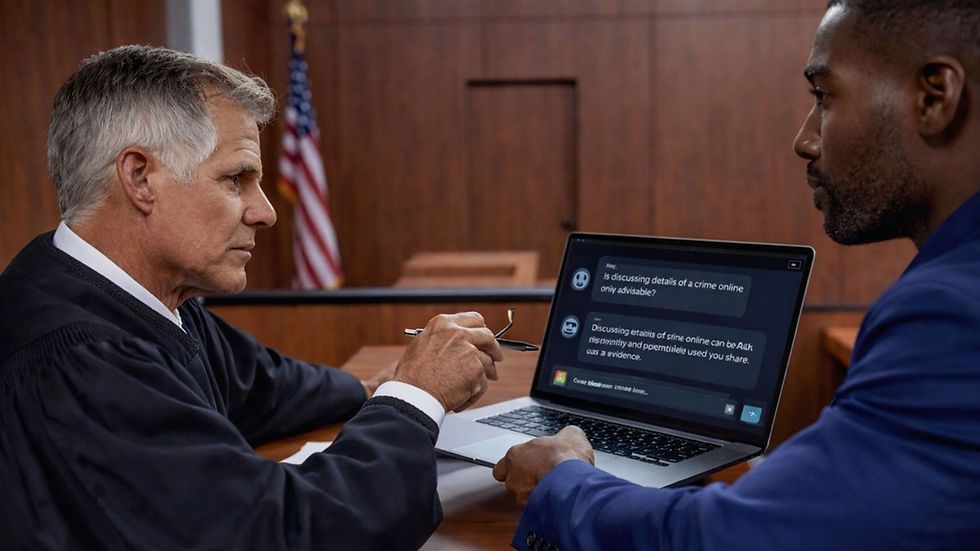
AI systems like ChatGPT, Google Gemini, and DeepSeek are the new confidants for millions of people worldwide, including Michiganders. And sometimes, people ask these systems questions they'd never ask a lawyer, a friend, or even a search engine. They view conversations with AI as private, disposable, and harmless.
However, in the world of Michigan criminal appeals, such assumptions can collapse almost instantly. The truth is very uncomfortable. AI companies keep your chat data. And your AI chats don't disappear. Instead, they live on servers. They can be traced back through account data, device identifiers, IP addresses, and timestamps.
In many criminal and civil cases, prosecutors, investigators, or appellate courts try to understand what happened in a case. They also seek to determine if a defendant's rights were violated. And your digital traces can suddenly matter a great deal in such scenarios.
Michigan appellate attorney Mark Linton has seen these issues play out in real cases, not just in theory, but in the trenches of post-conviction litigation. In this article, he explains how Michigan courts treat AI-generated conversations and the role they can play in criminal appeals.
Can Your Chats With AI Be Used as Evidence, And Can They Matter on Appeal?
Yes, AI chats can become evidence. They can be introduced at trial, and they can absolutely affect the outcome of a criminal appeal in Michigan. But like all evidence, their use is governed by strict evidentiary rules, constitutional protections, and appellate standards. These determine whether the chats were properly admitted in the first place.
Michigan law does not yet have a separate category for AI evidence. And AI conversations fall under the broader umbrella of Electronically Stored Information (ESI).
Michigan Rules of Evidence (MRE) make it clear. AI chat logs are treated like text messages, emails, social media messages, and cloud-based documents.
This means the logs are generally admissible if they meet the same foundational requirements. Several evidentiary rules play a key role when it comes to AI conversations.
MRE 401 focuses on relevance. And essentially, the evidence must make a fact more or less probable. MRE 402 deals with the admissibility of relevant evidence, while MRE 403 handles unfair prejudice vs probative value.
MRE 802, on the other hand, is the hearsay rule. It states that hearsay is not admissible unless a certain exception applies. Before any AI chat can be shown to a jury, the prosecution must first prove that it is authentic and reliable. And this is where most legal disputes begin.
The Biggest Issue of Authenticating AI Conversations
MRE 901 states that the government must show that the AI conversation is what it claims to be. That may sound simple theoretically, but it's very difficult practically.
A party introducing AI chat evidence must typically offer different forms of proof. This includes proving that that account belongs to the defendant, that chat logs were not altered, and the timestamps are accurate.
They must also demonstrate that the data was properly extracted from the platform and that the conversation reflects actual user input. And Michigan courts already apply these principles to digital evidence.
For instance, appellate courts in Michigan routinely admit text messages. But this only happens where proper authentication was shown through phone ownership, context, and corroborating evidence.
In People v. McDade (2013), Michigan courts recognized that properly authenticated electronic messages can be admitted into evidence, including as party-opponent admissions.
Also, under the Michigan Court Rules (MCR) 6.201, prosecutors may be required to disclose relevant electronic evidence. And this should happen during discovery if it is within the possession or control of law enforcement.
In criminal investigations, AI conversations may therefore be used to prove different aspects of a case. And these include intent, planning, knowledge of wrongdoing, consciousness of guilt, and inconsistent statements. This means that the conversations can be used to build or challenge a criminal case.
AI chats also raise additional complications. For example, AI responses are generated, not directly authored. Users may also paraphrase or misinterpret outputs, and logs can be edited, exported, or partially incomplete.
Moreover, server-side data may differ from what a user sees. And because of this, your defense counsel can challenge AI evidence as unreliable or insufficiently authenticated.
How AI Chats Enter the Trial Record in Michigan

For AI conversations to matter on appeal, they must first become part of the trial record. And this typically happens in one of four ways:
Search warrants - Police may seize your phones, laptops, browser history, or app data. And if AI usage is found, it can be extracted and preserved.
Subpoenas to AI companies - Companies behind AI systems can be compelled to produce chat logs, account data, IP logs, or timestamps.
Defendant device extraction - Forensic tools may recover stored chats, cached browser data, and app usage logs.
Voluntary statements - In some cases, defendants may screenshot chats, reference AI responses, or admit to using AI during interviews.
Once admitted at the trial court, these materials become part of the appellate record.
Incognito Mode Does Not Block Evidence From Collection
A common misconception is that private browsing or incognito mode protects AI conversations. And this means they can't be discovered or used in a criminal case. This is not true. Michigan criminal procedure and established search-and-seizure law explain it clearly.
Private browsing settings do not limit what service providers, internet companies, and law enforcement can lawfully obtain through the legal process. And once investigators obtain judicial authorization, electronically stored information can still be accessed from third-party providers and devices.
This process is governed by Michigan’s search warrant laws, including MCL 780.651 and related provisions, which authorize law enforcement to obtain electronic data through properly issued warrants.
Incognito mode only affects local device storage. It does not prevent server-side logging by the AI provider or IP address tracking through network activity.
The private mode does not hinder account-based identification tied to email or phone numbers. Neither does it prevent internet service provider (ISP) records from reflecting access history.
Michigan courts have consistently recognized in digital evidence cases that online activity can be reconstructed. And this can happen through metadata and records maintained by third-party providers.
In People v. Perlos (1990), the Michigan Supreme Court addressed privacy expectations in records held by third parties, recognizing that such information may be obtained and used when lawfully acquired. This principle helps explain how digital records, including data associated with AI usage, can become evidence in a criminal case.
Once a valid search warrant is issued under Michigan law, investigators may obtain a range of identifying digital information, including:
-IP address history associated with account access
- Login timestamps and session data
- Device identifiers linked to user accounts
- Payment or billing records tied to subscription services
These records can create a traceable digital footprint when combined. And they can connect you, the defendant, to specific AI activity, even if you believed the activity was private and untraceable.
How AI Evidence is Challenged in Michigan Courts
Your defense attorney will often attack AI evidence on several grounds:
Authentication under MRE 901 - Here, the advocate asks, was it really the defendant who created or used the account?
Hearsay under MRE 802 - Here, the question is, is the AI output being used for the truth of the matter asserted?
Reliability - Here, the focus is on whether the AI-generated content can be trusted as accurate or meaningful.
Chain of custody - Here, you ask if the data was preserved properly without alteration.
Rule 403 balancing - Here, the question is, even if the evidence is relevant, is it unfairly prejudicial? Michigan courts have broad discretion under MRE 403 to exclude evidence if it risks misleading the jury or causing unfair prejudice.
Constitutional Issues: The Fourth Amendment Problem
AI evidence often raises constitutional concerns under the Fourth Amendment (that deals with search and seizure), the Fifth Amendment (that handles self-incrimination) and due process protections. Michigan courts, as with many other courts, require that digital searches be supported by particularized warrants.
The courts emphasize that search warrants for digital devices must meet strict particularity requirements. This is especially the case when extracting communications or messages.
The Fourth Amendment requires warrants to clearly describe the specific areas or files, such as AI apps or logs, to be searched. They must also include the specific people or items they are allowed to seize. This safeguard ensures that searches are limited only to areas supported by probable cause.
And it also prevents law enforcement from conducting broad, open-ended searches that are untethered to any proper jurisdiction. A 2020 Amendment to the Michigan Constitution (Article I Section 11) explicitly protects “electronic data and electronic communications” from unreasonable searches and seizures.
And it requires a warrant supported by probable cause to access them. Sometimes, AI chat data is collected without proper authorization. In such cases, the data may be subject to suppression under the Exclusionary Rule. And that issue can become central on appeal.
How Mark Linton Shields You From Misused AI Evidence
What you typed into an AI system in seconds can be picked apart for months, or even years, in court. And when taken out of context, misunderstood, or improperly admitted, a single conversation can carry more weight than it should. And by the time you realize it, the damage may already be done.
Mark Linton knows how to stop that from happening. He is a deeply experienced appellate lawyer in Michigan who understands how appellate courts handle digital evidence. He has fought these battles before.
He knows how to challenge weak authentication, expose unreliable AI-generated content, and protect your constitutional rights on appeal.
If your case involves AI chats or digital evidence, don't wait to see how it plays out. The sooner you move, the more leverage you have. Contact Mark Linton today and make sure your side of the story is the one that stands.


Comments